Books That Predicted the Future
The Time Machine by H.G. Wells
by H.G. Wells
The 1895 novel that invented time travel fiction and warned of a terrifying future where comfort becomes the architect of humanity's downfall.
by H.G. Wells
The 1895 novel that invented time travel fiction and warned of a terrifying future where comfort becomes the architect of humanity's downfall.
Explore Wells' prophetic vision of humanity's future
Read H.G. Wells' groundbreaking 1895 novel that invented time travel fiction. Available free through Project Gutenberg.
Read Full TextDeep dive into Wells' social commentary and the science behind time travel concepts.
Download PDF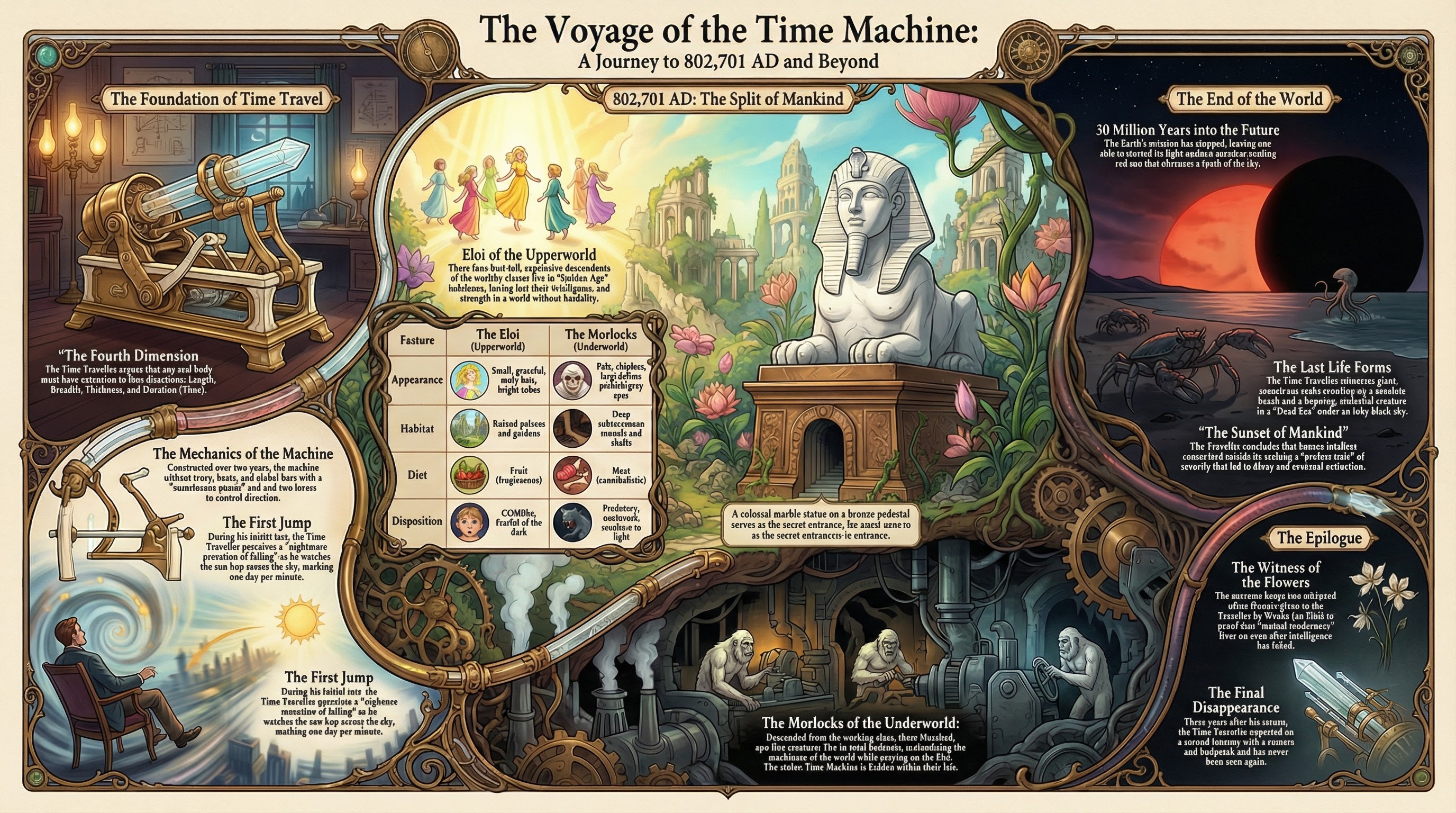
In 1895, H.G. Wells didn't just write a novel—he invented time travel fiction and delivered a chilling prophecy about humanity's future. What he revealed wasn't technological advancement, but biological regression caused by the very comfort we think will save us.
We are conditioned to view the future as a steady, ascending curve—a trajectory of technological mastery where every innovation further insulates us from the raw edges of existence. We assume that by perfecting our environment and eradicating suffering, we are securing the zenith of human potential.
Wells' Warning: The testimony of the Time Traveller reveals that the future is not merely a different society, but a terrifying biological mutation of our current values. The absolute comfort we crave is not the foundation of our advancement, but the very mechanism of our eventual decay.
Before confronting the visceral horrors of the future, Wells deconstructs our fundamental misunderstanding of reality. The Time Traveller posits that our school-taught geometry is a misconception. A real body must possess extension in four directions: Length, Breadth, Thickness, and Duration.
"There is no difference between Time and any of the three dimensions of Space except that our consciousness moves along it."
Upon arriving in 802,701 A.D., the Traveller discovers what he initially mistakes for a communistic paradise. The landscape is a "weedless garden," inhabited by the Eloi—frail, childlike descendants of humanity living in dilapidated palaces.
Yet this supposed "Golden Age" is merely the "Sunset of Mankind." Having achieved perfect conquest of Nature, humanity has surrendered the very stressors that once forged its strength. The Traveller observes that "security sets a premium on feebleness."
The true horror reveals itself: humanity has split into two distinct species. The "Upper-world" Eloi and the "Subterranean" Morlocks represent the ultimate conclusion of class division. The widening gulf between Capitalist and Laborer has become an unbridgeable biological barrier.
The Ultimate Reversal: The Morlocks, descendants of the working class, have become the true masters. In a gruesome reversal of Victorian social order, the Eloi have become the literal livestock of the Underworld.
The Traveller's observations distill a haunting philosophical takeaway: "intellectual versatility is the compensation for change, danger, and trouble." In a perfectly balanced environment where habit and instinct suffice, the flame of thought flickers out.
"Nature never appeals to intelligence until habit and instinct are useless," the Traveller observes. This serves as a grim prophecy for a modern society obsessed with total automation and the elimination of friction. By removing challenge from our lives, we risk dismantling the very forces that define our humanity.
The Traveller's journey concludes with a "Further Vision" thirty million years hence—a salt-encrusted beach under a giant, stationary, blood-red sun. The air is thin and "bitter cold," and the only complex life remaining are monstrous, sluggish crabs.
It is a vision of the universe's slow heat-death, where all human striving is silenced by the inexorable cooling of the stars. Wells didn't just predict social decay—he envisioned the cosmic finality of entropy itself.
Yet Wells offered one glimmer of hope. The Time Traveller returned with "two strange white flowers," given to him by Weena, an Eloi who had shown him genuine affection. These shrivelled specimens witness that even when "mind and strength had gone, gratitude and a mutual tenderness still lived on in the heart of man." As we continue building our world of total safety and effortless comfort, we must weigh the cost of our success. If necessity is what forged our intellect, what are we becoming as we continue to break it? Wells leaves us to wonder if our pursuit of a painless future is, in fact, the architecture of our own undoing.
Explore related works that share similar themes, time periods, or intellectual approaches.