Narrative Poetry / Satire
The Canterbury Tales
by Geoffrey Chaucer
29 strangers on the road to Canterbury create the first masterpiece in English — and accidentally invent the modern novel along the way.
by Geoffrey Chaucer
29 strangers on the road to Canterbury create the first masterpiece in English — and accidentally invent the modern novel along the way.
Discover how Chaucer's social experiment legitimized English as a literary language
Experience Chaucer's revolutionary work in its original form. Available free through Project Gutenberg.
Read Full TextIf you think The Canterbury Tales is just a collection of ribald medieval stories about pilgrims telling jokes to pass time, you're missing the most radical literary experiment in English history. When Geoffrey Chaucer decided to write in English instead of Latin or French, he wasn't just choosing a language — he was declaring that ordinary people's stories mattered as much as those of kings and saints.
But Chaucer's real revolution wasn't linguistic. It was social, psychological, and narrative. He created the first work where characters from every level of society — knight, miller, wife of Bath, pardoner, nun — share the same stage and tell their own stories in their own voices. No hierarchy, no moral filter, no authorial judgment. Just human beings revealing themselves through the stories they choose to tell.
The result? The blueprint for every novel, every character-driven narrative, every story that treats ordinary people as complex, contradictory, and fully human.
In Chaucer's time, serious literature was written in Latin (for the church and universities) or French (for the court). English was considered the language of peasants, merchants, and everyday life — fine for conversation, impossible for art. The very idea of creating literature in English was revolutionary.
Chaucer's decision wasn't just aesthetic — it was political. By writing in English, he was arguing that English culture, English experiences, and English people deserved literary treatment. He was democratizing literature, taking it away from the elite and making it accessible to anyone who could read their native language.
"Whan that Aprille with his shoures soote" — When April with his showers sweet
Those opening lines weren't just describing spring — they were declaring that English could be as beautiful, as sophisticated, and as worthy of serious attention as any classical language. The very sound of the verse proved that English literature was possible.
Medieval literature typically focused on one social class at a time: chivalric romances for nobility, saints' lives for the religious, fabliaux for the merchant class. Chaucer's masterstroke was putting everyone together on the same pilgrimage, forcing them to interact as equals united by a common journey.
The pilgrimage to Canterbury provided the perfect excuse for this social mixing. Pilgrims temporarily suspended normal social hierarchies — a knight could travel alongside a miller, a nun could listen to a wife's marriage advice, a pardoner could try to swindle a parson. The road was neutral ground where class distinctions softened.
But Chaucer's genius was showing how each character's story reveals their worldview, their anxieties, their humanity. The Knight tells a noble romance about courtly love and honor. The Miller immediately follows with a bawdy tale that mocks those very ideals. The contrast isn't accidental — it's the point.
"Here bygynneth the Book of the tales of Caunterbury"
This wasn't just entertainment — it was sociology. Chaucer created the first literary work to show how people from different backgrounds see the world differently, but also how they share fundamental human experiences: love, greed, ambition, fear, hope.
Alisoun of Bath isn't just memorable — she's revolutionary. In an age when women were expected to be silent, submissive, and sexually modest, Chaucer created a character who is loud, domineering, and frankly sexual. She's been married five times, enjoys sex, controls her own money, and has strong opinions about everything.
But the Wife of Bath isn't just scandalous — she's intellectually sophisticated. Her prologue draws on centuries of anti-feminist literature, then systematically dismantles those arguments through personal experience and clever logic. She uses the same scholarly techniques as male authorities, but applies them to defend women's rights and desires.
"Experience, though noon auctoritee / Were in this world, is right ynogh for me"
"Experience, though no authority existed in this world, is quite enough for me." This is the first literary statement that personal experience can be as valid as scholarly authority — especially when that authority systematically excludes your voice.
The Wife of Bath's tale — about a knight who must discover "what women most desire" — answers that women want sovereignty over their own lives. In the 14th century, this was radical feminism. Today, it's still relevant.
Modern literature is obsessed with unreliable narrators — characters whose biases, limitations, or outright lies shape the stories they tell. Chaucer invented this technique 600 years before modernist authors "discovered" it.
Every pilgrim tells a story that reveals more about themselves than about the characters they're describing. The Knight's tale emphasizes honor and noble suffering because he values those ideals. The Miller's tale mocks courtly love because he thinks it's pretentious nonsense. The Pardoner tells a story about greed being the root of all evil — then immediately tries to sell the pilgrims fake relics.
Chaucer's frame narrative — the pilgrimage itself — creates multiple layers of storytelling. Chaucer the author presents himself as Chaucer the pilgrim, who reports what other pilgrims said, who tell stories about other characters. Each layer adds irony, distance, and interpretive complexity.
"I am nat textuel; I wol nat glose" — I am not one for texts; I will not interpret
When the Wife of Bath says she's "not textual," she's being deeply ironic — her entire prologue demonstrates sophisticated textual analysis. This is Chaucer showing us that characters can be unreliable about their own methods, their own motivations, their own self-awareness.
Chaucer lived during one of the most corrupt periods in church history — the Papal Schism, the Black Death's aftermath, widespread clerical abuse. Rather than attacking the church directly (which would have been dangerous), he let his religious characters condemn themselves through their own words and actions.
The Pardoner openly admits he preaches against greed while being completely greedy himself. He sells fake relics, lies about their powers, and manipulates people's fear of damnation for profit. Yet his tale about greed being the root of all evil is morally sound — the messenger is corrupt, but the message is true.
The Prioress appears refined and charitable, but her tale reveals vicious anti-Semitism. She's more concerned with courtly manners than Christian charity, more interested in appearing holy than being holy.
"Radix malorum est cupiditas" — The root of evil is greed
The Pardoner's Latin motto is perfectly true — and perfectly describes himself. Chaucer's satire works by letting corrupt characters reveal their own corruption, making the critique impossible to dismiss as unfair or uninformed.
The Canterbury Tales was planned as a massive work: 30 pilgrims (including Chaucer) each telling two stories on the way to Canterbury and two on the return journey — 120 stories total. Chaucer completed only 24 tales before his death in 1400.
But the incompleteness isn't a flaw — it's strangely perfect. Real journeys don't have neat endings, real conversations don't resolve all conflicts, and real people don't reveal everything about themselves in one encounter. The abrupt ending suggests that human complexity can't be fully captured, only glimpsed.
The unfinished state also means we never see the pilgrims reach Canterbury. They remain forever on the road, forever in transition, forever revealing themselves through stories. The journey becomes more important than the destination — a very modern idea.
"And smale foweles maken melodye" — And small birds make melody
The spring opening suggests renewal, new beginnings, the eternal cycle of seasons. Perhaps Chaucer intended the work to feel cyclical, endless, like the stories we keep telling about ourselves and each other.
Chaucer wrote during a unique historical moment when English was rapidly evolving from Old English (think Beowulf) to Early Modern English (think Shakespeare). Middle English retained Old English complexity but gained French and Latin vocabulary from the Norman Conquest. The result was a language of extraordinary flexibility and richness.
Middle English could be earthy and elevated in the same sentence. Chaucer could describe the Wife of Bath's gap-toothed smile in crude, physical terms, then have her deliver sophisticated theological arguments. The language matched his democratic vision: high and low, sacred and profane, all deserving of literary attention.
Modern English is actually closer to Chaucer's language than his was to the Old English of 400 years earlier. With some effort, modern readers can recognize Chaucer's words, rhythms, and meanings. We're his linguistic descendants.
"Whan that Aprille with his shoures soote / The droghte of March hath perced to the roote"
These lines demonstrate Middle English's unique music: the alliteration of Old English poetry combined with the rhyming couplets Chaucer adapted from French literature. It's a hybrid language for a hybrid cultural moment.
Before Chaucer, literary characters were typically idealized or allegorical — perfect knights, pure saints, embodiments of virtues or vices. Chaucer created the first psychologically realistic characters in English literature: complex, contradictory people who contain multitudes.
The Wife of Bath is simultaneously a feminist pioneer and a materialistic social climber. The Pardoner is both a cynical fraud and a skilled preacher who genuinely moves his audiences. The Knight is honorable but naive, the Miller is crude but perceptive. None of them can be reduced to simple moral categories.
This psychological complexity became the foundation of the modern novel. When novelists create characters who surprise us, who change over time, who embody contradictions — they're following Chaucer's example. Every antihero, every morally ambiguous protagonist, every character who defies easy categorization traces back to Canterbury.
"And she was cleped madame Eglentyne" — And she was called Madam Eglentyne
The Prioress's pretentious French name reveals her vanity, but the gentle sound suggests genuine refinement too. Chaucer understood that people are never just one thing — and that understanding revolutionized storytelling forever.
The Canterbury Tales asks a question that remains urgent 600 years later: How do we live together when we see the world so differently?
Chaucer's pilgrims represent every possible perspective: religious and secular, noble and common, male and female, young and old, idealistic and cynical. They disagree about everything — love, money, religion, power, justice. Yet they share the same road, the same destination, the same human condition.
The poem suggests that our differences don't have to divide us. Stories can bridge divides that arguments cannot. When the Miller mocks the Knight's idealism, he's not just being crude — he's offering an alternative vision of how the world works. When the Wife of Bath challenges male authority, she's not just being rebellious — she's demanding that women's experiences be taken seriously.
In our own age of political polarization and cultural division, maybe that's exactly what we need: the patience to listen to stories that challenge our assumptions, the humility to recognize our own biases, the wisdom to see that multiple perspectives can coexist.
The pilgrims never reach Canterbury in Chaucer's version. They're still on the road, still telling stories, still revealing themselves to each other and to us. Maybe that's the point — the journey toward understanding never really ends.
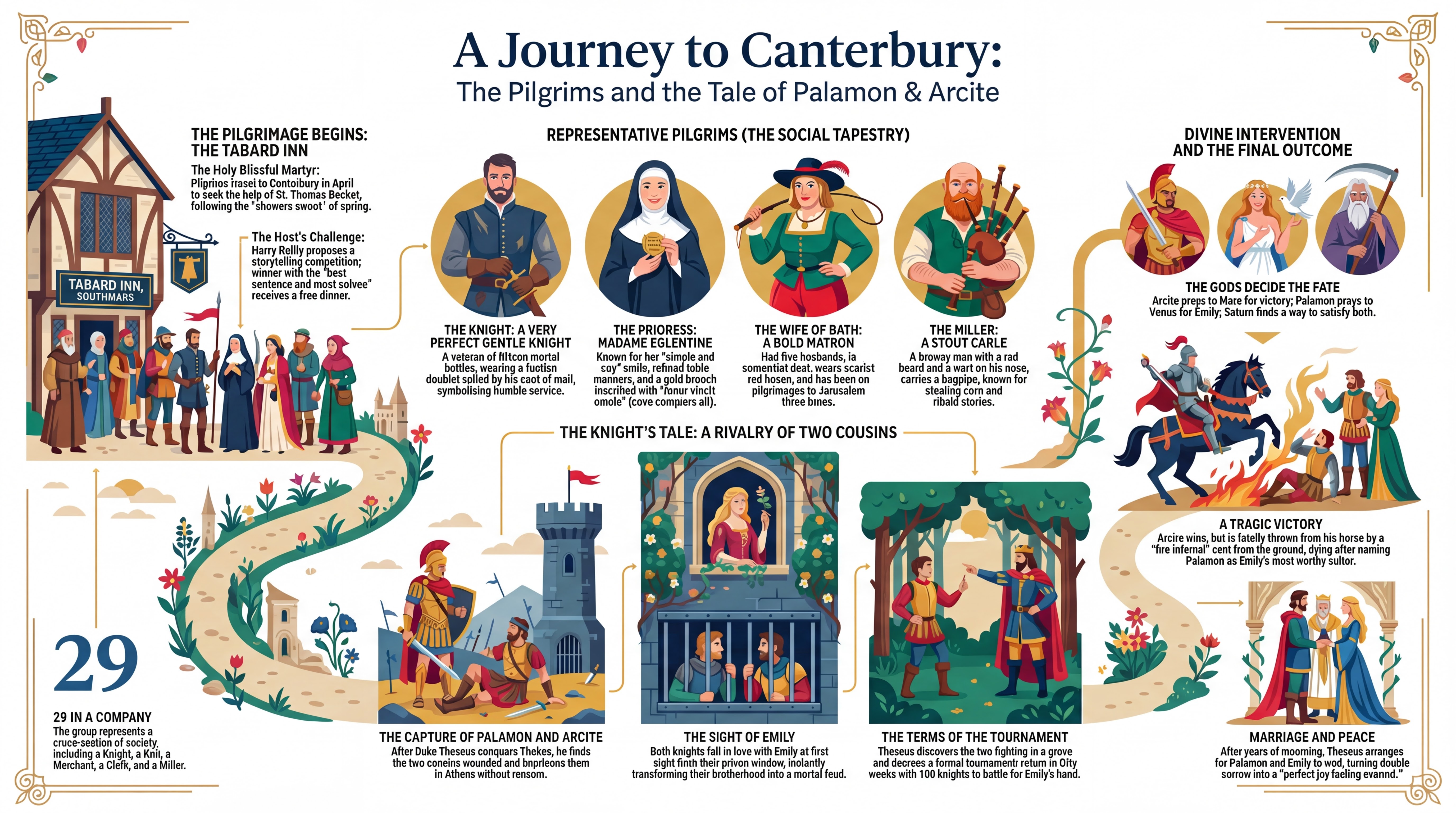
Chaucer assembled representatives from every level of 14th-century society, creating literature's first truly democratic cast of characters.
Explore related works that share similar themes, time periods, or narrative innovations.