Military Strategy
The Art of War by Sun Tzu
by Sun Tzu
The ancient military strategy guide that reveals timeless principles of competitive advantage and the supreme skill of winning without fighting.
by Sun Tzu
The ancient military strategy guide that reveals timeless principles of competitive advantage and the supreme skill of winning without fighting.
Master Sun Tzu's principles of strategic thinking and competitive advantage
Experience Sun Tzu's timeless strategic wisdom in its original form. Available free through Project Gutenberg.
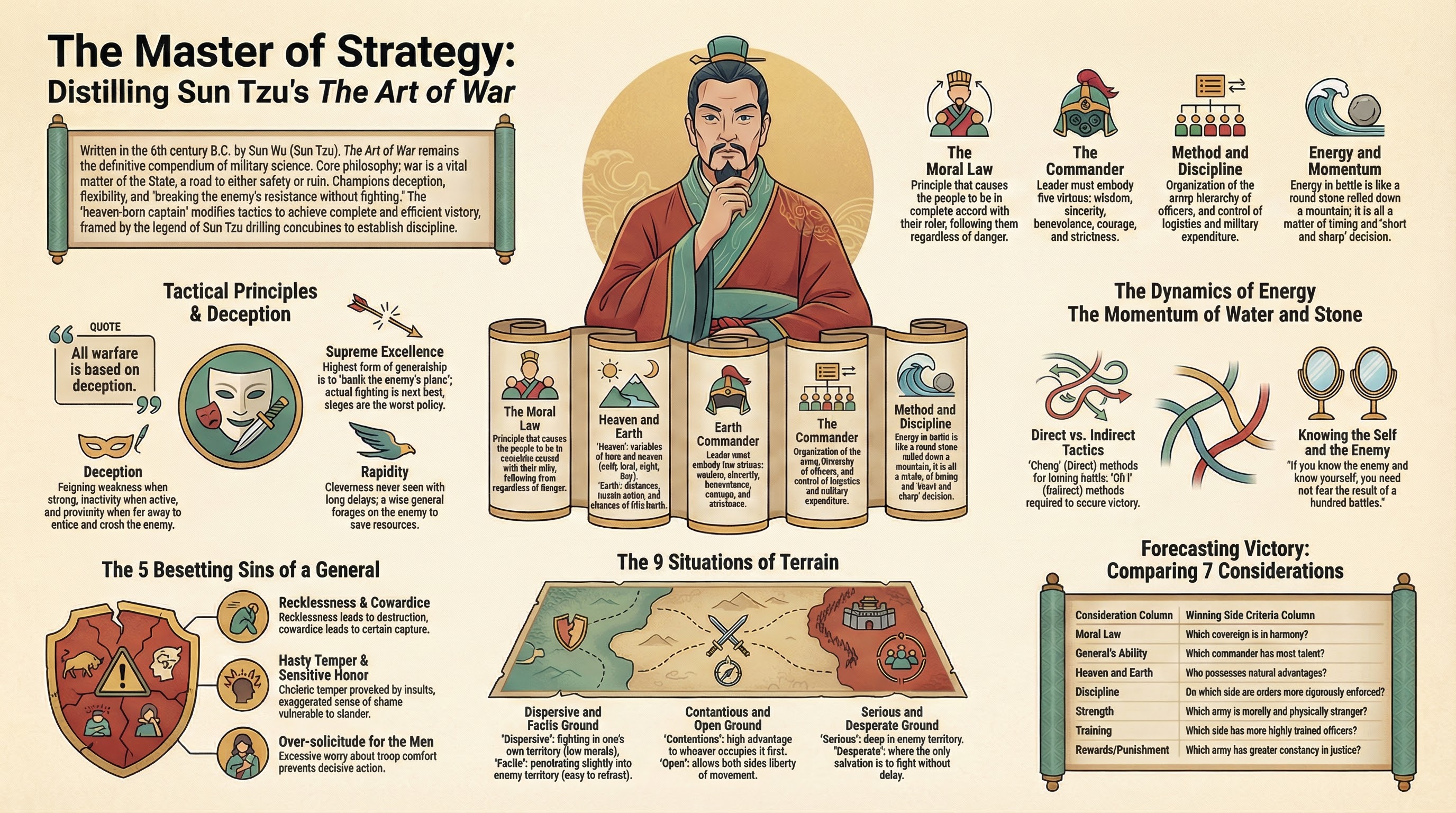
Read Full TextEnhanced PDF edition with annotations and visual infographic summary of key strategic principles.
Written over 2,500 years ago by the Chinese military strategist Sun Tzu, The Art of War remains one of the most influential books on strategy ever written. While its original context was military warfare, its principles have been adopted by everyone from corporate executives to professional athletes, from politicians to startup founders seeking competitive advantage.
What makes Sun Tzu's approach revolutionary is his emphasis on intelligence over brute force, adaptability over rigid tactics, and psychological warfare over physical destruction. At its core, The Art of War is about achieving your objectives with minimal conflict, maximum efficiency, and strategic superiority. It's the original handbook for competitive intelligence and strategic thinking in any arena where stakes matter.
Sun Tzu's most profound insight is that the ultimate strategic victory comes not from defeating your enemy, but from making victory inevitable before any conflict begins. The highest form of warfare is to frustrate the enemy's strategy, not to destroy their army.
"To fight and conquer in all your battles is not supreme excellence; supreme excellence consists in breaking the enemy's resistance without fighting."
Modern Application: This principle explains why the most successful companies often avoid direct competition. Instead of engaging in price wars or feature battles, they create new market categories, build insurmountable moats, or position themselves in ways that make competition irrelevant. Amazon didn't beat bookstores by being a better bookstore—they redefined what selling books could mean.
The goal is to create conditions where your victory is so inevitable that rational opponents surrender without a fight, or better yet, never challenge you in the first place. This isn't just about military or business competition—it applies to any situation where you want to achieve your objectives efficiently and sustainably.
Perhaps Sun Tzu's most famous maxim provides a mathematical certainty about the outcome of any contest. The quality of your intelligence—both about your own capabilities and your opponent's—directly determines your probability of success.
"If you know the enemy and know yourself, you need not fear the result of a hundred battles."
The Four States of Knowledge:
Most strategic failures occur not because of poor execution, but because of poor intelligence. Companies fail because they don't understand their own strengths and weaknesses, or they don't understand their market and competition. Personal failures often stem from the same root: overestimating our abilities or underestimating the challenge we face.
Sun Tzu's approach to deception isn't about lying—it's about information asymmetry and strategic misdirection. The goal is to shape your opponent's perception of reality so they make decisions that serve your interests rather than theirs.
"When able to attack, we must seem unable; when using our forces, we must seem inactive; when we are near, we must make the enemy believe we are far away; when far away, we must make him believe we are near." This isn't just military trickery—it's the foundation of all strategic advantage.
Strategic Misdirection in Practice: Apple's famous secrecy isn't just about preventing leaks—it's about controlling the narrative and timing of information. Netflix kept its shift to original content quiet while appearing to focus on licensing, then surprised competitors who had grown comfortable with the status quo. Even in negotiations, the most effective approach is often to appear less interested or capable than you actually are.
Sun Tzu understood that time is the ultimate strategic resource. Speed allows you to exploit opportunities before they disappear, respond to threats before they materialize, and compound advantages before competitors can react. The faster force often wins not because they are stronger, but because they act while others hesitate.
"Rapidity is the essence of war: take advantage of the enemy's unreadiness, make your way by unexpected routes, and attack unguarded spots." This principle explains why startups can disrupt established industries, why first-mover advantages are so powerful, and why decisive action often beats perfect planning.
The Speed Advantage: In business, technology, and personal development, the ability to learn, adapt, and execute quickly creates compounding returns. While competitors are planning, you're executing. While they're executing their first plan, you're already iterating on your second. Speed doesn't just help you win—it helps you win more decisively and at lower cost.
However, Sun Tzu warns against reckless speed. True strategic speed comes from thorough preparation and clear objectives, not from rushed action. When you know exactly what you want and have prepared thoroughly, you can move with decisive speed when the moment is right.
Sun Tzu's most elegant metaphor compares strategic excellence to the behavior of water: "Water shapes its course according to the nature of the ground over which it flows; the soldier works out his victory in relation to the foe he is facing." Water is infinitely adaptable yet inexorably persistent.
Water doesn't fight obstacles directly—it flows around them, gradually wearing them down, or finds alternative paths. It takes the shape of any container while maintaining its essential nature. It can be gentle enough to nurture life or powerful enough to reshape landscapes, depending on what the situation requires.
"Be extremely subtle, even to the point of formlessness. Be extremely mysterious, even to the point of soundlessness. Thereby you can be the director of the opponent's fate."
This water-like approach to strategy means adapting your tactics to the specific terrain and opposition you face, while never losing sight of your ultimate objective. It means being flexible in method but unwavering in purpose. The most successful strategic thinkers embody this water-like quality: they are formless enough to adapt to any situation, yet directed enough to flow inevitably toward their goals.
What makes The Art of War enduringly relevant is its focus on the psychological and informational aspects of competition rather than specific tactics or weapons. Sun Tzu understood that the most important battles are fought in the mind—both your own and your opponent's.
His strategic principles work because they recognize fundamental truths about human nature: our tendency to act on incomplete information, our susceptibility to deception and misdirection, our respect for strength and speed, and our preference for avoiding unnecessary conflict. These psychological constants make his insights as applicable to modern boardrooms and digital battlefields as they were to ancient warfare.
The question isn't whether you're engaged in competition—you are. The question is whether you're thinking strategically about it, or simply reacting to whatever comes your way.
Explore related works that share similar themes, time periods, or intellectual approaches.